Posts

Showing posts with the label Green your kitchen

A few more green tips

Hope you all had a nice Earth Day today. Here are a few more tips and links to conclude this week's blogging marathon. You can access all these posts by clicking the Green Your Kitchen tab at the top of this blog. Origin and Nature of your Food Many factors contribute to the energy bill of the food we eat: The type of food it is (Livestock consumes a lot more energy than fields of vegetables for instance)  The way it is produced (Is the food produced organically or with the use of petroleum products for instance?)  The distance it travels before reaching your kitchen  The type of transportation used and the quantity transported on each trip  The amount of processing involved in producing the food The type of packaging used Although some of these variables are difficult to determine, keeping them in mind and being as well informed as you can will help you choose healthy, tasty, and eco-friendly foods. (This is true for drinks too, including water.) Cooking Methods Th...

Unplugging small appliances

Image
There is time for one more post before Earth Day tomorrow. This week I have told you about freezer and refrigerator temperatures , hot water temperature , and  energy-efficient lighting . Let's talk about one more way to save electricity. Most electric appliances consume energy as soon are they are plugged in, whether they are actively used or not. The power is drawn from digital clocks and displays, remote controls, or voltage regulators, and can be as high as 10 to 15 watts. This standby power is sometimes called "phantom load." How to measure your energy usage You can use a wattmeter to measure the electric power of any device plugged to an outlet. (Some public libraries lend wattmeters.) Plug the wattmeter to the electric outlet. Plug the device to the wattmeter. Read the power usage in watts when the device is running. Read the power usage in watts when the device is in standby mode (that is, plugged in but not performing its main function). You can then compute the...

CFL vs. LED vs. Incandescent Light Bulbs

Image
Compact fluorescent lamps (CFLs) use about 75 percent less energy than standard incandescent bulbs and last up to 10 times longer. Light emitting diode bulbs (LEDs) seem to be even more attractive, as they use the same amount of energy as CFLs, but last at least 15 times longer than incandescent bulbs. They may eventually replace CFLs as their price goes down. Replacing incandescent light bulbs with CFLs or LEDs A CFL or LED bulb will produce the same brightness, or light output, as an incandescent bulb, while requiring less power. Use the Energy Savings Calculator provided below to determine the power and energy savings obtained for each light. The energy savings depend on how long the light is turned on during the day. Energy Savings Calculator Old Bulb Power: Watts New Bulb Power: Watts Daily Bulb Usage: hours/day Electricity Rate: $/kWh –––––––––––––––––––––– Power Savings: Watts Yearly Energy Savings: kWh/year $/year (Numbers are shown as an example. Enter your own data...

How much water comes out of your tap?

Image
To continue this week's Green Your Kitchen series, I will show you how to measure your kitchen faucet flow rate . Your faucet's flow rate indicates how much water passes through your faucet during a given amount of time. In the U.S., it is often measured in gallons per minute (gpm). The bigger the flow rate, the more water you consume. The recommended flow rate is 1.5 gpm or less, which ensures proper pressure while minimizing water consumption. However most fixtures have a flow rate of 2.2 gpm or more, according to Energy Savers . Recommended water flow rate:  1.5 gallons per minute or less How to measure the water flow rate To measure your faucet's flow rate, follow these simple steps: Open the faucet completely. Collect cold water in a graduated container for an exact period of time (for example 4 seconds). Measure the amount of water collected. Convert your measurement to gallons per minute. Use the Water Flow Rate Calculator provided below to convert your measurement ...

Is your hot water too hot?

Image
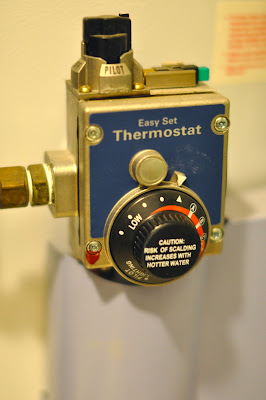
Now that you have tuned up your refrigerator and freezer temperatures , how about tuning down your water heater ? Heating water accounts for 19 percent of a household's energy bill. Hot water should be set to no more than 120ºF to avoid scalding and heat loss. Recommended water temperature: 120ºF (48.9ºC) How to measure the water temperature Measure the hot water temperature at the faucet that is the closest to your water heater, that is, where the hot water travels the shortest distance from the water heater. Pour hot water in a container, plunge a water-proof thermometer, and wait until it stabilizes before reading the temperature. If you have to dial down the water heater's setting, wait 24 hours before performing a new measurement. Other tips for saving energy Providing adequate insulation around your water tank and pipes will help you keep hot water hot. Buying guide If you are about to buy a new water heater, you should consider one of the following options, as recommende...

Is your freezer too cold?

Image
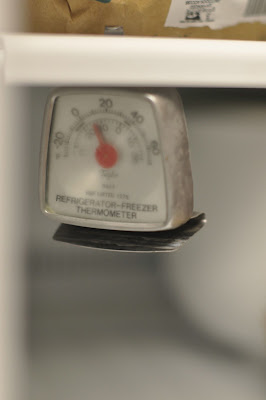
To continue this week's Earth Day special Green Your Kitchen  series, let's talk about  refrigerator and freezer temperatures . Your refrigerator and freezer account for about 5 percent of your household's energy usage. By setting them to the optimal temperatures, you can save substantial amounts of energy. Recommended temperature settings: Best 1 Maximum 2 Freezer    0ºF    5ºF    -17.8ºC -15ºC Refrigerator    35–38ºF 42ºF 1.7–3.4ºC    5.6ºC 1 Best temperature settings for energy efficiency 2 Highest temperature allowed for food safety How to measure the temperature To measure the temperature in your refrigerator or freezer, follow these instructions: Place a refrigerator thermometer in the center of your refrigerator or freezer, between two packages or food items. Close the door and wait for at least 20 minutes until the thermometer stabilizes. Read the temperature as soon as you take the thermomet...

Earth Day Challenge

Image
This Sunday, April 22, is Earth Day . A day dedicated since 1970 to mobilizing "people of all nationalities and backgrounds [to] voice their appreciation for the planet and demand its protection." I appreciate our planet, so for the occasion of Earth Day, I will blog all week about the "little" things you can do in your kitchen (and around the house) to save energy and water. Little things with a big impact! I hope you will find these tips useful. I would love to hear about your own precious Earth-preserving tips. You can leave comments on this blog, on my Facebook page or on Twitter . So let's get started... Day 1—Introduction Green Your Kitchen  Over 20 percent of the energy used in the United States is consumed in residential houses 1 . In addition, over 3.8 billion gallons of water are used in residences every day 2 . If we combine our efforts, saving energy and water at home will have a huge positive impact on our environment. This week's blog posts wi...